
Leave It on the Trail: Recharging Your Social Battery Together
Ask Magalie Remy what kind of kid she was at a party, and she gives you the picture right away: the one in the corner with a book. She grew up in Brooklyn, where the closest thing to a forest was a single tree on the block, and she describes herself as quite introverted, then and now. Her social battery has always run on a smaller charge than the room around her.
That is not the profile of someone who ends up leading five hundred women into the woods. But it is where the story starts.
Years later, during the pandemic, her birthday came around and there was nowhere to go. Her friend Wanda Spanks asked what she wanted to do. They could try to find somewhere that was open, or they could go hiking. Wanda had done it before. Magalie never had.
So they went to a mountain outside Atlanta. Not the rough side with the roots and rocks, but the paved road where the trucks drive. Magalie was careful to say it was not a parking lot. It was, for her, a first.
Something happened on that road that neither of them had planned. Two friends who were tired, overextended, and starved for real conversation found that walking under trees made the talking easier. The conversations went deeper than they did anywhere else. Something organic happened, in Magalie’s words. They started going back. And somewhere in those return trips, the walk took on a job of its own. Whatever had been sitting heavy on them all week got said out loud on that paved road, in the open air, to someone who was actually listening. Then it stayed there. They left it on the mountain, and they walked back down lighter than they had come up.
Over time, others started joining them. What began as a birthday outing became Soul Sistas Hike Too, a mindful hiking community for women, most of them over forty, that now numbers around five hundred. And yet the woman at the center of it still keeps a book handy, still needs quiet, and still knows exactly how much she has to give on a given day. Her social battery did not get bigger. She built a community that fits it.
Stories like hers are more common than they sound. They are just rarely told from the corner of the room.
A Social Battery Is Not a Character Flaw
We talk about a social battery the way we talk about a phone charge. It drains when we spend time with people, it refills when we are alone, and some of us seem to start each day at forty percent. The phrase has become shorthand for a real and common experience: wanting connection and feeling too depleted to go get it.
Our own data shows how widespread that feeling is. In our State of Connection in America 2026 report, the single most common barrier people named to building connection was being too tired or too busy. Forty-three percent of American adults said so, ahead of every other reason. Another thirty-two percent said they were uncomfortable going to social events alone, and thirty percent said they were scared or nervous to put themselves out there.
Read those numbers together and a pattern appears. Most people are not opting out of connection because they do not want it. Their social battery is running low, and the connection on offer looks like one more thing that will drain them.
That is the trap of the social battery. When every gathering costs energy, the sensible move is to skip the gathering. Skip enough of them and the isolation compounds. Our report found that fifty-two percent of U.S. adults now fall in the at-risk or vulnerable range on the Social Connection Index, the measure we use to track the six everyday behaviors that add up to a connected life. Being tired is not a small thing. It is the front door to disconnection for half the country.
Susan Cain made a similar case in Quiet, her book on introversion. A third to a half of people, she argues, are wired to find stimulation costly rather than energizing, and most of our social structures are built by and for the other half. The introvert is fine. The design is what assumes everyone recharges the same way.
Magalie did not set out to fix that design. She just built something that worked for her social battery.
The Community of Play That Recharges a Social Battery
We call groups like Soul Sistas a Community of Play, one of the Six Points of Connection, our framework for the everyday behaviors that research links to a connected life. A Community of Play is any group that does an activity together, from run clubs to book groups to pickup basketball. Only about thirty percent of Americans belong to one, but the ones who do tend to pick up the other five points more easily. Play is the entry point.
Most of the Communities of Play we hear about on How We Connected run hot. Midnight runners, roller skaters, sauna circuits. They are wonderful, and they are built for people with a full social battery. Magalie built the other kind.
Soul Sistas calls what it does mindful hiking. The group scouts every trail in advance, down to where the nearest bathroom is, because if you are inviting people and setting the table, you make sure they have what they need. Hikes run two to four miles. Everyone learns names first. There is stretching, a round of small wins from the week, and then the walk, with intentional stops for conversation along the way. At the end, before anyone gets back in the car, the group sits down together for a meditation to let the morning settle.
We asked Magalie whether she files these hikes under rest or under activity. She did not hesitate: rest. That is why they are specific about the word mindful. There is movement, but there is also a lot of standing around under trees, smelling the roses, taking pictures, sometimes playing music. Nobody is chasing a summit. The journey is the point.
Hear Magalie’s full story on How We Connected.
That distinction, rest or activity, turns out to be the whole game for people with a limited social battery. The same hike with a different group and a different pace would cost energy. This one gives it back. The activity is the same. The design is not.
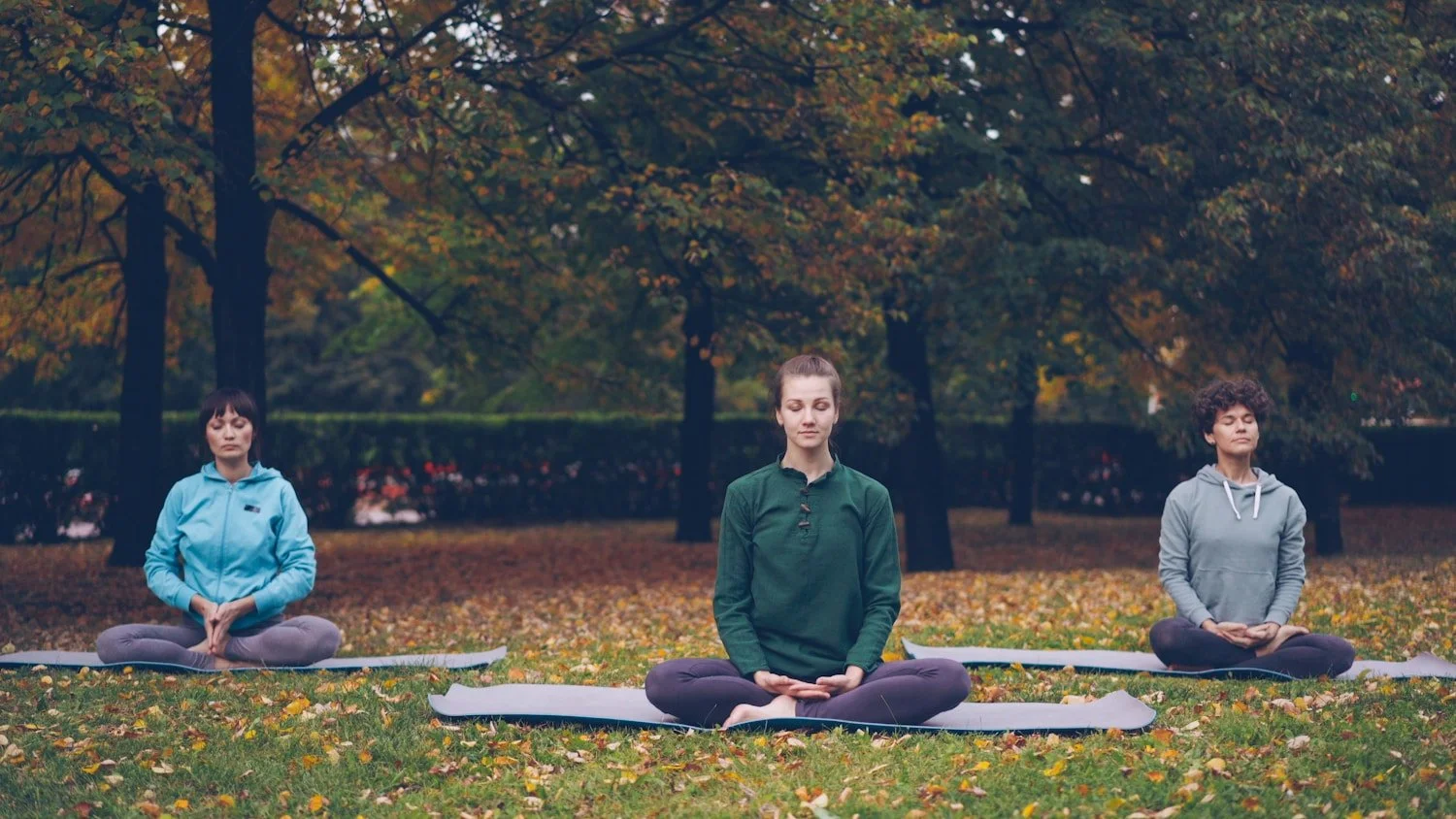
Photo: Vitaly Gariev / Unsplash
What the Woods Do for a Drained Social Battery
There is a reason a walk under trees restores something a coffee shop does not. Environmental psychologists Rachel and Stephen Kaplan spent decades studying why natural settings leave people feeling replenished, and their Attention Restoration Theory offers a clean explanation. Cities and screens demand directed attention, the effortful kind that tires us out. Nature invites what the Kaplans called soft fascination, attention that is held without effort by moving leaves, water, and light. Directed attention gets a break, and it recovers.
A social battery works on the same circuit. Small talk, reading a room, performing energy you do not have: all of that is directed attention pointed at other people. Put the same people on a trail, side by side instead of face to face, with the trees doing some of the work, and the cost of being together drops. You can be quiet and still be present.
Magalie has watched this happen with hundreds of women, and the theme that comes up most on the trail is not loneliness exactly. It is over-performance, overthinking, and the isolation that follows. Women who run households, teams, and families, and who have never been given permission to rest. The reflections on each hike are built around that. Where do you need a boundary? Where could you ask for help? What are you carrying that you could set down here?
Our co-founder Charlotte Massey recognized the pattern when we spoke with Magalie. “What I need is something restorative,” she admitted, “but I feel like I have to push myself and do something that is running around the world, climbing mountains.” Even the people who build communities for a living can mistake exhaustion for a reason to try harder.

Photo: Trent Haaland / Unsplash
Small on Purpose
The part of Magalie’s story that surprises people is the size of the hikes. Soul Sistas has grown to about five hundred women, and each hike still holds around sixteen. She chose that number. “We’d still keep it small, the actual hikes,” she told us, “because that intimacy and connection is what’s important to us.” She wants to be able to see each woman in nature and hear what the morning did for her.
For someone with a modest social battery, sixteen is a number you can hold. You can learn every name. You can have one real conversation and not feel like you failed at the other forty. Small is the design that makes showing up possible.
It also took a long time to get there. In the early days, after the first few friends came and went, Magalie and Wanda put out an open call, and plenty of mornings it was still just the two of them. They kept going anyway. If it was going to end that way, she jokes, they would end in a blaze of glory. That comfort with a small room is something we hear from nearly every community builder we interview, and it is the opposite of the social media illusion that a real community arrives all at once. Groups like this grow the way trust grows, one repeated morning at a time.
The connections travel, too. Women who met on a Soul Sistas trail now go to museums together and take trips together. Once, four or five women from nearly the same Midwestern town discovered each other in Atlanta and started hanging out back home. None of that was the plan. It is what happens when a space is built so that people with a low social battery can stay long enough to be known.
Someone Still Carries the Pack
None of this is effortless, and Magalie is honest about that. People from other states have asked her how to build what she built, and she wants to train other women to lead hikes so the community can grow without losing its intimacy. She is building digital resources and beginning to offer private wellness experiences for organizations. All of it takes time from two women who started this because they were the ones who needed rest.
When we asked about the over-performance her hikers describe, she did not put herself outside of it. “I’ve been there. I’m probably still there,” she said.
That is the tension we cannot resolve for her. The people best at building restorative space for others are often the ones still learning to take it for themselves. Every community of this kind runs on the energy of someone whose own social battery is not infinite. That is worth naming, even without a fix.
Being, Not Doing
Our founder Aaron Hurst has a phrase for two ways of moving through the world: human beings and human doings. Most of us, he admits, spend our weeks as human doings, going and going until we crash. What Magalie built is a place where women who spend their lives doing get a few hours to just be, and to come back to their lives with something restored rather than something spent.
Magalie says the doing part her community has down. The being is the practice. “The being is just recognizing our existence is enough,” she says, and then she adds that they are still working on it.
She was the kid in the corner with the book. She still is, in a way. She did not become someone with a bigger social battery. She found the road on the side of the mountain where her charge was enough, and then she left the gate open for anyone else who needed it.
If your social battery is low and connection feels like one more thing to survive, the lesson from the trail is not to push harder. It may be to look for the version of togetherness that gives energy back. Side by side, outdoors, small, and slow. And if it does not exist near you yet, it might start the way this one did: two people, one walk, and the decision to go again.
Where to Start This Week
Pick the walk. If a gathering sounds draining, offer a walk instead. Text one person you have been meaning to see and put a thirty-minute walk on the calendar. Side by side is easier on a low social battery than face-to-face across a table.
Go small on purpose. You do not have to build up to a big group. Two or three people, the same route, the same day each week. Repetition does the work that intensity cannot, and it asks far less of your social battery.
Leave it on the trail. Try Magalie’s practice. Before you head home, take two minutes to say out loud, to yourself or to whoever walked with you, what you are setting down this week. Then let it stay there.
Decide what kind of space you are in. Whether you are joining a group or hosting one, ask a simple question first: is this rest or is this activity? Both are good. Knowing which one you are walking into changes how you show up, and how much energy you bring home.
Join the People Rebuilding Connection, One Walk at a Time
If Magalie’s story sounds like something your city needs more of, the Welcome Committee is a good place to start. Volunteers join neighbors to welcome newcomers, host small gatherings, and help rebuild connection one relationship at a time, at whatever pace works for you.